Pikliz Recipe from Haiti

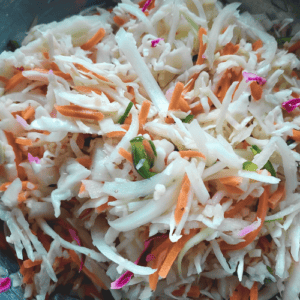
Pikliz is a spicy, tangy condiment made primarily from pickled cabbage, carrots, bell peppers, onions, and Scotch bonnet peppers, seasoned with vinegar and spices. It adds a burst of flavor to Haitian dishes, particularly fried foods like griot (fried pork) and fried plantains, yum!

Pikliz is often made in large batches and stored in jars, allowing it to be preserved for extended periods. Storing food is especially important for Haitians as they are often faced with food insecurity. We believe no child should go hungry. Our program in Haiti served over 10,000 meals to children in need last year. 

We hope you enjoy this delicious Haitian staple as much as we do and that it connects you in a deeper way with our extended Haitian family

Pikliz (Haiti)

Forward Edge International
Pikliz is typically used as a condiment on fried foods like griot (fried pork) and fried plantains, enhancing their taste and providing contrast with its acidity and heat. But honestly it's great on it's own as a summer side dish or when you need something crunchy with a bit of heat. Connect with our Haiti program by enjoying this recipe and learn how we're helping children in Haiti at www.forwardedge.org/haiti.
Prep Time 15 minutes
Cook Time 0 minutes
Course Side Dish
Servings 6

Ingredients
  

  • 1 cabbage
  • 2 carrots
  • 1 onion
  • 3 Scotch bonnet peppers or jalapeños
  • 4 garlic cloves
  • 2 tsp salt
  • 8 peppercorns
  • 1 cup white vinegar

Instructions
 

  • Cut the cabbage in half and using a shredder, shred one of the halves into a bowl.
  • Repeat the process for the carrots, onion, peppers, and garlic cloves.
  • Add the peppercorns, salt, and vinegar to the bowl. Mix all the ingredients thoroughly.
  • Transfer all the contents of the bowl including liquids into a large glass container and store in the refrigerator for at least 24 hours to allow the pickling process to complete.

Notes

Store in your refrigerator for up to three weeks.
Keyword condiment, crunchy, haiti, pikliz, slaw, spicey
living on mission

Growing Through Trials in 5 Practical Ways

Though generally joy-filled, one of the difficult aspects of the Christian life are the troubles we encounter in the midst of following and trusting God. Jesus and the apostles tell us in God’s Word that this will be a common experience for us, and it raises the question of how

Go to Blog »
child sponsorship

4 Tips to Grow Closer to Your Sponsored Child

As a child sponsor for over 3 decades, and now as the Child Sponsorship Administrator for Forward Edge, I am often asked (and challenged myself) about how to best communicate with a sponsored child. In almost all cases, the children we sponsor live in other countries. We do live in

Go to Blog »
community

Jollof Rice Recipe from Ghana

Jollof rice is THE signature meal of Ghana. The classic Jollof recipe varies a bit region to region (in fact, Ghana and Nigeria have a friendly ‘rivalry’ over whose jollof is better). It is made using tomatoes, peppers, onions and spices from the region and is often served alongside fish or fufu. In

Go to Blog »
From our CEO

Life Advice Part 2: You Were Made to Serve

Tim Ainley, CEO of Forward Edge, recently shared an inspiring message at a graduation commencement ceremony that is a timely and impactful message for us all. But, especially for recent graduates, young adults, and teens, these words could be the guiding principles you need as you step into a world

Go to Blog »
Transform a Child's Life Through Sponsorship

Ka wula (hello), my name is Nashiru

  • location

    Ghana

  • 16 yrs. old

    05-29-2009

Entered the program: March 2023

Nashiru lives with his aunt, uncle and five cousins. He lost his father and mother when he was seven years old, and his uncle took him in. They live in a house built with mud and roofed with thatch. They have access to electricity but no access to a latrine. The only water source is the village dam, until the dry season; then, the women in the community must travel long distances to find other sources.

Nashiru’s uncle is a small-hold farmer who cultivates groundnuts, maize and rice, but he barely harvests enough food to take care of the family. Nashiru’s aunt is a housewife who sometimes sells shea butter to help with the household income but it is sporadic and minimal. Nashiru’s aunt and uncle find it difficult to provide the basic necessities for all of the children. Thanks to Create Hope, the family now receives food packages and Nashiro no longer has to go to school with an empty stomach.

Sponsorship Level What's this?

Three $38 sponsorships are needed to cover the complete holistic care of one child. Cover one, two, or three sponsorships.